Bolivia
Russians need no visa for up to 90 days in 180, citizenship after 3 years of stay, a child born in Bolivia is a citizen. The rate floats since June 2026: 11.97 Bs per dollar on 6 October 2026.
Key figures
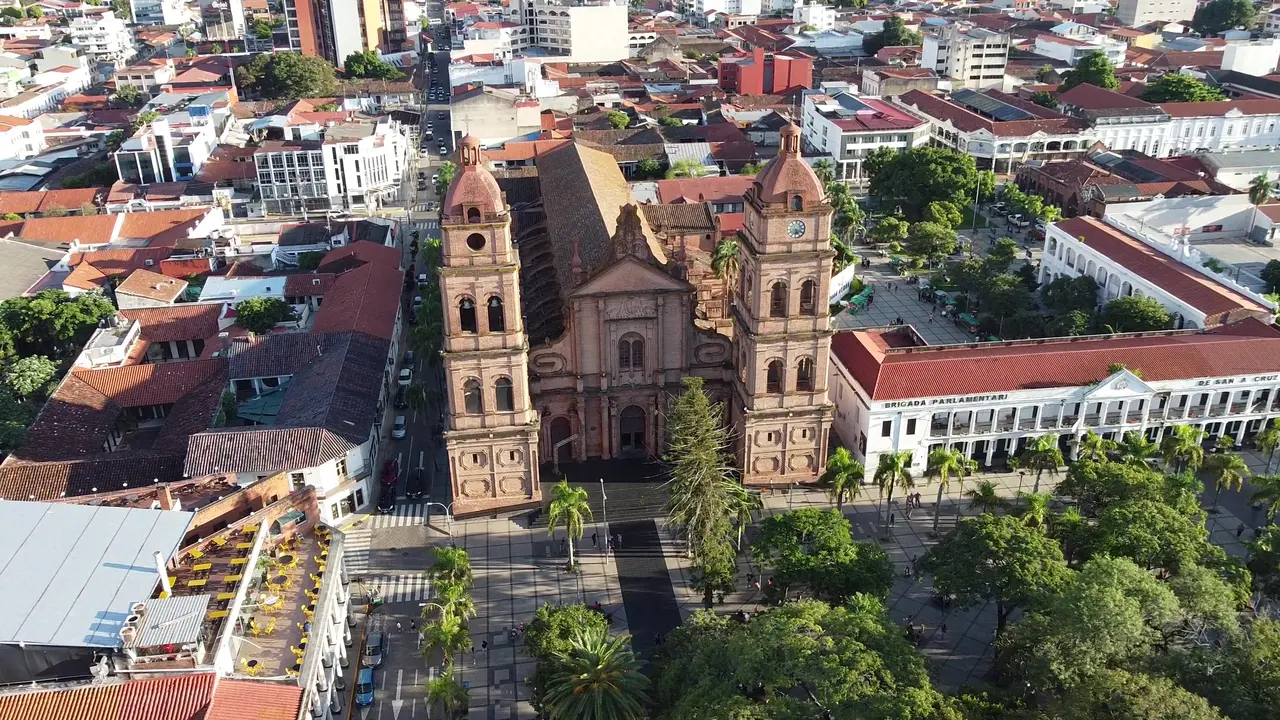
Cities
Housing and money
Updated 6 Oct 2026
The currency is the boliviano (Bs). The rate floats since 26 June 2026: on 6 October 2026 it was 11.97 Bs per dollar. Banks sell dollars at most 0.10 Bs above it.
OfficialBanco Central de Bolivia: official exchange rate on 6 October 2026 and the timeline of the move to a floating rate · 6 Oct 2026
details
Home page of Banco Central de Bolivia on 6 October 2026: the official rate (Tipo de cambio oficial) is 11.97 bolivianos per dollar. According to the bank's own timeline, from February 2023 the country had a balance-of-payments crisis and a shortage of dollars, a parallel market appeared and a gap opened between the official rate and other quotes; inflation reached a level not seen for 37 years. From 1 December 2025 the bank publishes a reference rate based on actual deals of banks with clients, on 6 April 2026 it abolished the ceiling and floor of the rate for banks and exchange offices, and on 26 June 2026 it approved, by Resolution 88/2026, a new regulation on foreign exchange operations: the bank itself calls this a full abandonment of the fixed rate. Now the official rate is calculated every business day as the weighted average rate at which banks buy dollars from clients, and it is published on the bank's website at 20:00 and applies the next day; banks may not sell the dollar above the official rate plus 10 centavos. The rate changes daily, so a budget should use the rate on the date.
INE: prices rose 5.7% in the 12 months to September 2026 and 3.9% since January. The central bank says 2025 inflation was the highest in 37 years.
OfficialINE: consumer price index for September 2026 · 6 Oct 2026
details
INE press release of 5 October 2026: the consumer price index in September 2026 rose 0.85% in a month, 3.88% since the start of the year and 5.70% over twelve months. In September tomatoes, soft drinks, potatoes, bus and minibus fares, mobile phones and onions rose the most. By city the monthly increase ranged from 0.05% in Trinidad to 2.26% in Sucre; 0.76% in the La Paz conurbation and 0.38% in the Santa Cruz conurbation. Banco Central de Bolivia writes in its timeline (entry of 1 December 2025) that inflation reached a level not seen for 37 years, comparable only to the start of the hyperinflation of the 1980s. The INE poverty line table shows how prices rose: the urban poverty line per person went from 1048.6 Bs at the end of 2024 to 1327.5 Bs in December 2025, almost 27% more.
A foreigner moving to live in Bolivia may bring household goods duty-free up to 35,000 dollars. Cars are not covered by this exemption.
OfficialSupreme Decree No. 1639 of 10 July 2013: duty-free import of household goods (text in the Lexivox database) · 6 Oct 2026
details
Supreme Decree 1639 of 10 July 2013 rewrote article 192 of the customs law regulation: household goods (menaje doméstico) are exempt from import duties up to 35,000 dollars FOB value for non-resident foreigners entering to settle in the country; they include clothing, furniture, appliances and other items of ordinary household use. For returning Bolivians the limit is 35,000 dollars, and 50,000 with work tools. Decree 371 of 2009 also says directly that cars are not household goods. Separately, Decree 29836 of 3 December 2008 banned the ordinary import of passenger cars (tariff heading 87.03) older than five years in the first year, four in the second and three years from the third year of the decree; for buses and trucks the thresholds are 7, 6 and 5 years. We did not check whether this limit still applies unchanged.
Documents
Updated 6 Oct 2026
Temporary stay is granted for 1, 2 or 3 years, up to 3 years in total. After 3 years one can apply for permanent stay, which extends at once to the spouse and children.
OfficialLaw No. 370 on Migration of 8 May 2013 (text in the Lexivox database) · 6 Oct 2026
details
Migration Law No. 370 of 8 May 2013. Article 30: temporary stay (permanencia temporal) is granted to those who entered legally, for up to three years in one of these variants: 1 year renewable twice for a year, 2 years renewable for a year, or 3 years at once; there is also a humanitarian 1-year stay for those who for a good reason cannot gather the documents. Grounds: study, work, medical treatment, family. Article 31: permanent stay (permanencia definitiva) is granted to those with at least three years of stay who expressly request it; it extends to the spouse, dependent children and dependent parents without the three-year requirement. Article 34: with temporary or permanent status one must obtain a foreigner's identity card (cédula de identidad de extranjero). The law refers document requirements and fees to the regulation (Decree 1923 of 2014 with amendments), which we did not open; Law 997 of 2017 did not change these articles.
Citizenship can be requested after 3 years of stay, or after 2 with a Bolivian child or spouse. A child born in Bolivia is a citizen by birth.
OfficialPolitical Constitution of the Plurinational State of Bolivia of 2009, articles 141-143 (text in the Lexivox database) · 6 Oct 2026
details
Constitution of 2009, article 141: Bolivians by birth are all those born on Bolivian territory, except the children of foreign diplomatic staff, as well as those born abroad to a Bolivian mother or father. Article 142: naturalization is possible for foreigners in legal status with more than three years of uninterrupted residence in the country under state supervision who expressly state their wish to become Bolivian. The period is reduced to two years for those with a Bolivian spouse, Bolivian children or Bolivian adoptive parents, and for those who have done military service. Article 143: a person who acquires Bolivian nationality is not required to renounce the previous one. Migration Law 370 (articles 41-42) repeats the conditions: three years of continuous stay, a lawful activity in the country, proven original nationality, the other requirements in the regulation; Law 997 added that naturalization is granted by the president by resolution. So a child born in Bolivia shortens the parents' path to citizenship to two years.
Russian citizens do not need a visa: up to 90 days in every 180 under the 2016 intergovernmental agreement. Living and working longer requires a separate status.
SpecialistAgreement between the governments of Russia and Bolivia on visa-free travel of citizens, Moscow, 12 April 2016 (text in the ppt.ru legal database) · 6 Oct 2026
details
The agreement between the governments of Russia and Bolivia on visa-free travel was signed in Moscow on 12 April 2016. Under article 1, holders of valid ordinary passports may enter, leave and stay in the other country without a visa for up to 90 calendar days in every 180-day period from the date of first entry. Anyone who wants to live there longer than 90 days or to work and do business must obtain a visa or permit under the laws of the country of entry. We saw the text in a reprint in the ppt.ru legal database; the date of entry into force and Bolivia's current list of countries by visa group could not be checked on official sites (the Migración Bolivia site and the Russian Foreign Ministry sites did not open for us). Under Migration Law 370, a short stay (tourism, study, work, medical treatment, family) is called permanencia transitoria and lasts no more than 180 days. These sources say nothing about citizens of other former Soviet countries.
Family and health
Updated 6 Oct 2026
Public care is free under SUS for those without social security. Foreigners get it on reciprocity; pregnant women, children under 5 and people 60+ always.
OfficialLaw No. 1152 of 20 February 2019 “Towards a single, universal and free health system” (text in the Lexivox database) · 6 Oct 2026
details
Law 1152 of 20 February 2019 “Towards a single, universal and free health system” amended Law 475. Article 5: free care in public facilities is given to Bolivians without short-term social security (Seguridad Social de Corto Plazo, that is, insurance through an employer); to foreigners without such insurance within international treaties, on the principle of reciprocity and on the same terms as Bolivians. Other foreigners in Bolivia receive free care if they are pregnant women (from the start of pregnancy until six months after birth), women for sexual and reproductive health, children under five, people aged 60 and over, and people with a certified disability. Care is provided according to a list of services set by the Ministry of Health. These sources do not say whether there is a reciprocity treaty with Russia; private clinics are not part of the system, and we did not check their prices.
Place
Updated 6 Oct 2026
Since 17 December 2025 regular gasoline costs 6.96 Bs per liter instead of 3.74, diesel 9.80 instead of 3.72. Bottled gas stayed at 2.25 Bs per kg.
OfficialANH: regulated prices of petroleum products for the final consumer on the domestic market, 2010 - August 2026 · 6 Oct 2026
details
Table of regulated final-consumer prices of the Agencia Nacional de Hidrocarburos (uploaded 14 September 2026, last row for 31 August 2026). Especial gasoline cost 3.74 Bs per liter until 6 October 2025 and 6.96 since 17 December 2025; diesel 3.72 and 9.80; Premium gasoline 4.79 and 11.00 (on 30 June 2026 the last price, after that it is not in the table); vehicle gas (GNV) 1.66 and 2.73 Bs per m³; kerosene 2.72 and 5.64. Liquefied gas (GLP) has cost 2.25 Bs per kilogram in the table since 2010, so a 10 kg cylinder costs 22.50 Bs (our calculation). At the central bank rate of 11.97 on 6 October 2026, a liter of Especial gasoline is about 0.58 dollars.
Residency and citizenship
Five routes to a residence permit and the approximate time to a passport. Citizenship: 3 years of residence.
- Remote worknot confirmeda passport needs another routeNo separate visa; permanencia temporal por trabajo (Ley 370, Art. 30)
- Pension or rentnot confirmeda passport needs another routeNo separate category (DS 1923, Art. 13)
- Local jobwith conditionspassport ~3 yearsPermanencia temporal por trabajo (Ley 370, art. 30; DS 1923, art. 13)
- Marriage or citizen childopenpassport ~2 yearsPermanencia temporal por familia (DS 1923, art. 13)
- Investmentwith conditionspassport ~3 yearsNo separate investor permit; permanencia temporal por trabajo
This is a reference on the law as of the check date, not legal advice. Rules change: before applying, check with the migration service or a specialist. The ≈ sign on an income threshold means the law sets it in local currency; we converted it to dollars at the rate on the check date. Data checked 6 Oct 2026.
Do you live here or help people move?
Add yourself for free: a profile with a photo, contacts, and the topics you can talk about.
Updated 6 Oct 2026